
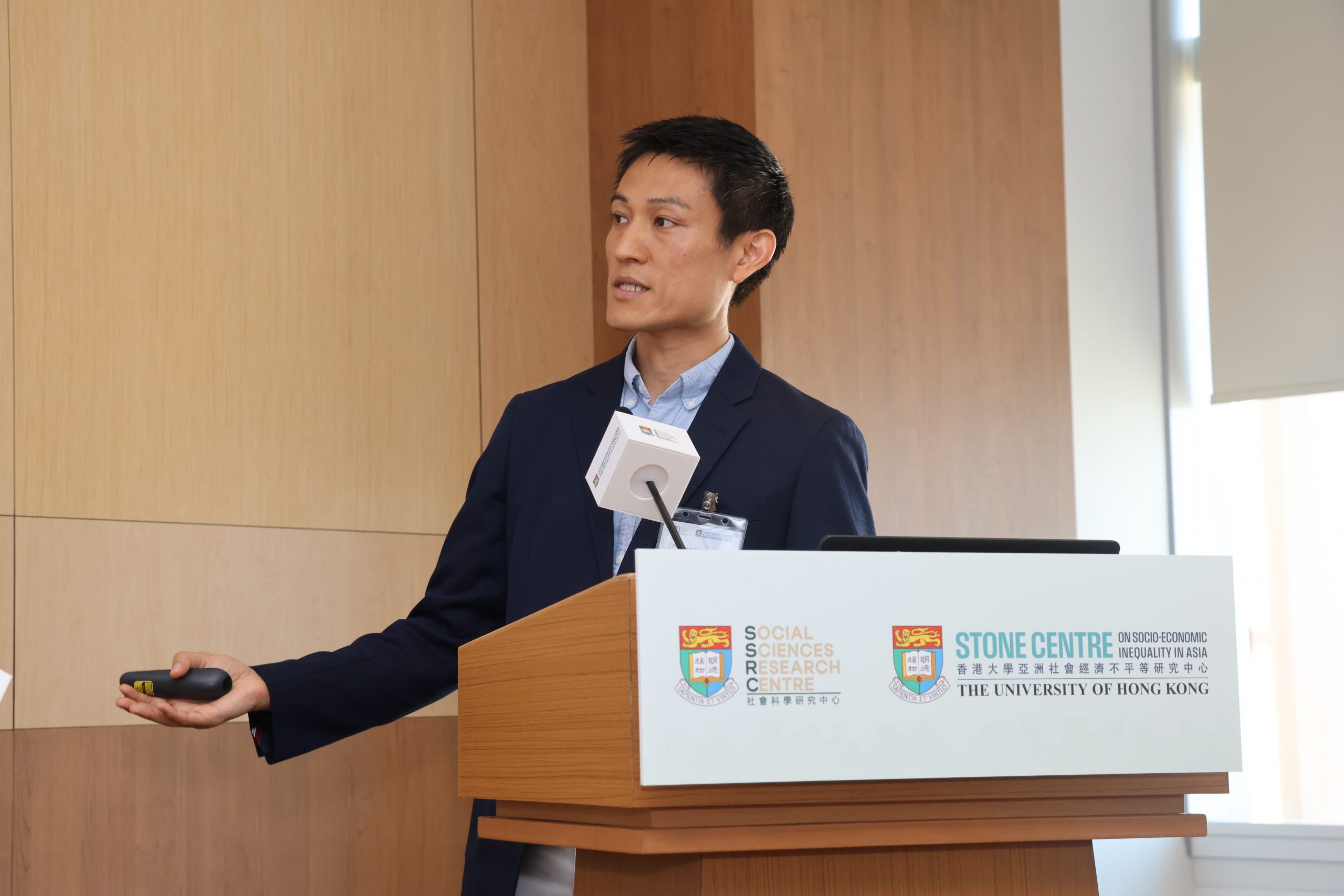
Satoshi Araki, Assistant Professor in the Department of Sociology at the University of Hong Kong, examines the relationship between education, skills, and intergenerational inequality in his paper, “Education, Skills, and Intergenerational Inequality in Status Attainment: Causal Mediation Analysis and Typology of 23 OECD Countries.” The paper was presented at the Centre’s Workshop on Socio-Economic Inequality in China and the World on 25 March 2026 and has recently been published in the British Journal of Sociology. The study proposes a new framework – the OESD quadrangle – and offers insights into how education and skills shape the transmission of advantage and disadvantage across generations. It has important implications for understanding and addressing socioeconomic inequality and develops a comparative typology of societies.
About the research
This paper asks how socioeconomic inequality is reproduced through offspring’s education and skills, and how the structure of intergenerational inequality varies across societies. Extending a fundamental framework in the field – the OED triangle, the study proposes a new framework, the OESD quadrangle, which incorporates origin (family background), education, skills, and destination (socioeconomic status).
Using data form the OECD Survey of Adult Skills (PIAAC) across 23 countries and applying causal mediation analysis, the study finds that both education and adult cognitive skills significantly mediate the origin-destination association. It further shows that the mediating power of adult skills varies across countries, ranging from 4% in Sweden to 25% in the United States of the total origin effect. This variation may reflect the extent to which societies are governed by meritocracy and credentialism.
These findings suggest that fostering cognitive skills among disadvantaged individuals may help mitigate intergenerational inequality, although the potential impact differs cross-nationally. The paper contributes to ongoing debates on socioeconomic inequality, intergenerational mobility, and the social function of education and skills.
Why it matters
This research is especially timely because the reproduction of socioeconomic inequality remains a crucial yet unsolved social problem worldwide. By highlighting the distinct role of skills alongside education in the intergenerational transmission of socioeconomic status, the study deepens our understanding of the mechanisms of persistent inequality across different national contexts.
Key takeaways
- Advantages and disadvantages associated with family background, such as parental education and affluence, are significantly transmitted to offspring’s socioeconomic status through educational attainment and skills.
- The extent to which education and skills mediate the relationship between social origin and socioeconomic status varies substantially across countries, arguably reflecting the meritocratic and credential nature of each society. In societies where skills play a larger mediating role, promoting skill development among disadvantaged individuals may help mitigate intergenerational inequality.
- The OESD quadrangle, which focuses on the association among social origin, education, skills, and destination, provides a useful framework for understanding the mechanisms of intergenerational inequality and developing typologies of societies.
Author’s quote
“This study extends the fundamental framework in stratification and educational research – the OED triangle – by explicitly incorporating skills as a critical mediator. The proposed new framework – the OESD quadrangle – helps better elucidate nuanced mechanisms of intergenerational inequality, including their cross-national variation, and develop societal typologies. Alongside scholarly merit, the findings also inform policy aimed at addressing socioeconomic inequality and accelerating social mobility. I hope that the study inspires further research and policy discussions with closer attention to the role of skills.” – Satoshi Araki
About the scholar
Satoshi Araki is an Assistant Professor in the Department of Sociology, the University of Hong Kong. He holds his DPhil in sociology from the University of Oxford and an MA/BA from the University of Tokyo. Prior to starting his academic career, he had extensively contributed to policymaking as a consultant for the World Bank/Global Partnership for Education, a researcher at the Mitsubishi Research Institute, and a fellow of the Southeast Asian Ministers of Education Organization – Regional Centre for Higher Education and Development (SEAMEO-RIHED). His current research ranges from social stratification and inequality to the sociology of education and work, well-being, and research methods. His work has appeared in top journals across disciplines, such as the American Sociological Review, Socio-Economic Review, European Sociological Review, Social Science & Medicine, Higher Education, Journal of Happiness Studies, and Social Psychological and Personality Science. He also serves as an editorial board member of Sociology, flagship journal of the British Sociological Association.
Publication note
Araki, Satoshi. 2026. “Education, Skills, and Intergenerational Inequality in Status Attainment: Causal mediation analysis and typology of 23 OECD countries”, The British Journal of Sociology. https://doi.org/10.1111/1468-4446.70139
Key links:
- Paper / working paper / preprint: https://doi.org/10.1111/1468-4446.70139
- Personal profile page: https://sociology.hku.hk/people/satoshi-araki